
The completion of the WB&A bike trail and a successful Tour de VRE combined to give me an idea for a little bicycling adventure – taking commuter rail to explore the trail.
On an October Friday afternoon, I took a half-day from work and headed over from Barracks Row to Union Station to catch a MARC to Odenton.

Link: MARC Penn Line schedule
Complications
Did you know that if a MARC doesn’t have a standing rack on it, customers need to have two bungie cords to secure their bike? Ask me how I found out.
In short, I was kicked off the 424 leaving at 2:15 p.m. Maybe the 424 had other cars with standing racks, but the conductor didn’t share that information.
My solution was to bike over Frager’s Hardware, by a couple of bungie cords and then head back to Union Station. I arrived in time for the 426 at 3 p.m.
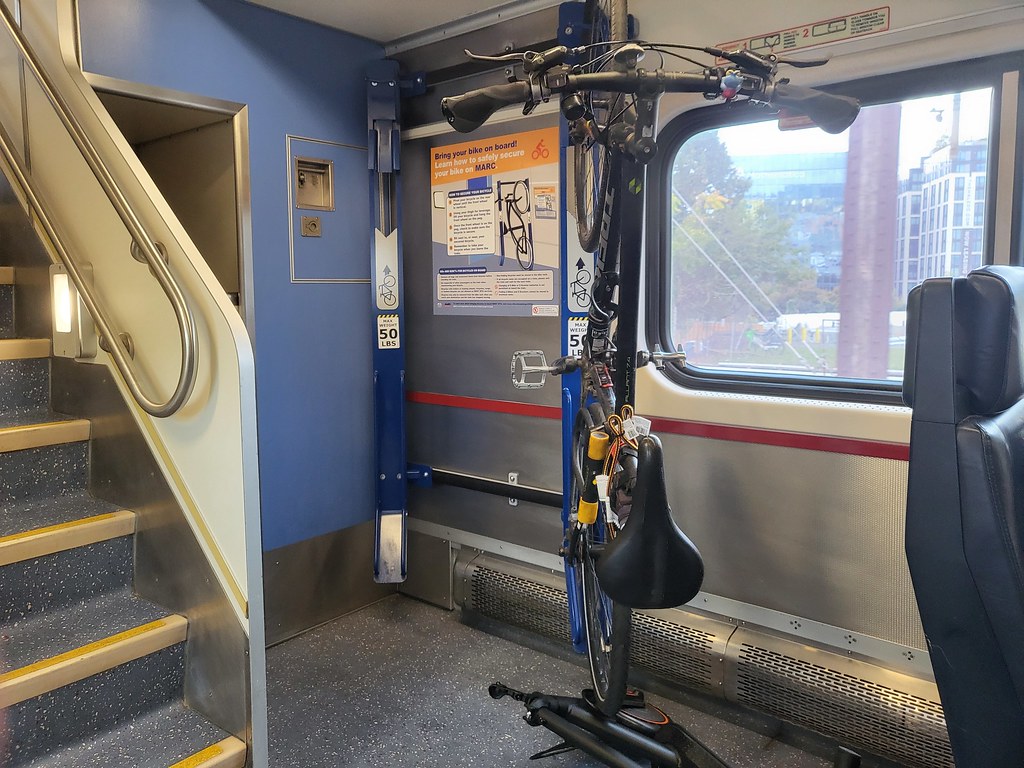
The train I was on this time had a standing rack, so the bungie cords weren’t even needed. Of course, I had to get on first and Union Station is not a high level platform. I have some experience getting onto trains that way.12
Payment
There are three options for buying a ticket:
- A fare machine inside Union Station
- Paying cash to a conductor
- Using the MARC app, CharmPass

Leaving Union Station (called Inbound by MARC), I purchased my $7 ticket from a fare machine. It’s more similar to what baseball tickets3 used to be than say, an old-school Metro farecard.
Heading Outbound to Union Station, I paid cash to the conductor, $6. I liked her better than her colleague from earlier.
Unlike Amtrak, MARC does not add a surcharge for bicycles.
Exiting Odenton

The platform at Odenton is long, so no need to be in a certain care on my train. It was also a high-level platform so getting the bike off was easier than getting on at Union Station. It was a simple exit onto Odenton Road and over to the WB&A.
Entering at Seabrook

When planning my ride, I considered biking over to the New Carrollton Metro station. However, since I started later than planned, I could catch one of the few trains to Union Station in the afternoon rush, 443, without any more waiting than it would likely take me to get to the Orange Line.
I didn’t see any signs from the WB&A Trailhead to MARC Seabrook like I did on the northern end for MARC Odenton. I didn’t see any from MD 450 Annapolis Road either. There is a wide sidewalk/multi-use path along that road all the way to Seabrook Road. Other than one overgrown section, it was a low-stress ride. Seabrook was on-road, but traffic was reasonable, so I wasn’t bad.
It took a little figuring out how to get to the station platform and then to find the tunnel under the tracks. Time was on my side though, so I even took a sidequest to a convenience store on the other side of Lanham-Severn Road.
While I waited, I saw several trains go by, though sadly, not a brand new Acela. The old Acela though blew past me and I certainly felt it. I wouldn’t call myself a foamer,4 but it was an experience.

Final thoughts
Even with the complications, taking MARC to explore “new to me” bike trails is worthwhile. I anticipate doing it again some time soon, before it gets too cold. I’m considering going up to BWI Airport station and heading over to the B&A Trail towards Annapolis via the BWI Trail. I might even check out some Baltimore city trails some day.
The WB&A Trail trail worked well, because I didn’t have to turnaround to get back on the trail. As I mentioned, I could have taken to the WMATA Orange line within a reasonable distance of the trailhead or even taken a Metrobus to get to there. The B&A Trail will require going back to where I started.5
There is a catch though…
MARC service is commuter-focused – it’s Maryland Rail Commuter after all. There are service limitations, including:
- The Camden Line only has 9 trains a day on weekdays to Washington and 11 to Baltimore. No weekend service is available.
- Only four weekday MARC trains travel the Brunswick Line , split between Frederick and Martinsburg, WV terminals. So, that pretty much rules out going out to Brunswick and biking back along the C&O canal towpath unless it’s right around the summer solstice. It doesn’t run on weekends either, though Amtrak does on a limited basis. But that incurs bike surcharges.
- The Penn Line has some weekend service though and on Saturday, it’s hourly during parts of the afternoon. Sunday is much less though and Seabrook is not on the schedule either day. Trains generally don’t reach the Perryville terminus6 on weekends either. That’s for Amtrak.
So, recreating this specific ride by MARC isn’t doable on the weekend, but including the WMATA Metro Orange line can be done without taking PTO. I was thinking of taking a day for B&A via MARC, but may do it on a Saturday instead.
Regardless, there are several options for combining MARC and bike trails into a different, low-cost adventure.
Footnotes
- From 2023: A cursory look at Philadelphia’s SEPTA regional rail, subway and PATCO ↩︎
- 2025 Tour de VRE recap ↩︎
- See Miles in Transit for an example ↩︎
- No disrespect, I subscribe to several transit YouTubers ↩︎
- Because Annapolis doesn’t have rail…it hasn’t for a long time, but we got a rail trail out of it! ↩︎
- Did you know that the gap between Perryville and Newark, Del. is the longest gap between commuter rail between Fredericksburg, Va. and Connecticut? There is a $2 connector though between MARC and SEPTA though (Rail Passengers Maryland). A real rail connection (WBOC) has been considered in the past. Miles in Transit covered DC to Boston using only local transit in 2023 too. I don’t recommend recreating, but you do you. ↩︎