
On March 27, 1976, the Washington Metropolitan Area Transit Authority began rail service. Red Line service between Rhode Island Av and Dupont Circle.
Metro celebrates 50 years of service to the region | 50th Anniversary site – WMATA
This humble start, a “toy subway” as Prof. Zachary Scrag2 described it, grew into the nation’s second largest rapid transit system by mileage and ridership – 98 stations and 128 miles of revenue track.
I do not think it can be overemphasized what a miracle Metro is for this region. Not even 15 years after the interstate highway system was enacted, the District, Virginia and Maryland went against the dominant ideology of only designing transportation systems for cars. Other regions like the San Francisco Bay Area and Atlanta tried, but none of them reached the extent of Metro. The federal government, really the 4th “state” involved played a big role, of course, but at the same time sometimes held things up. The jurisdictions in the WMATA compact were brave in building rail when they did.
Metro was the catalyst for so much regrowth of the area’s traditional urban cores – not just downtown D.C., but other neighborhoods and much of Arlington, Silver Spring and Bethesda.
My early Metro years
Metro has been a part of my personal history since I was 9 years old.3 My father took my brother and I to the opening of the Orange Line to Vienna. We enjoyed a free ride to Dunn Loring and back.
When I was a teenager, I’d bike to the Vienna station, lock it up and ride into the District sometimes. There were still lines under construction – the Green Line was in separate sections and even the Red Line wasn’t finished.
When I was in my 20s, it meant going out at night without the hassle of a car .Sporting events and nightlife – all much easier with Metro. Proximity to Metro was a big factor in moving to Pentagon City. Since I had to be at work at 5 a.m. four days a week, I didn’t commute much via Metro which was a shame because it was faster door to door than driving.
The maps was changing again too – the Green Line was finally finished, but Blue Line was being extended east. The Red Line was getting an in-fill station. It didn’t even occur to me back then that I would someday commute to that station or that it could be a neighborhood christened NoMa.3 The Silver Line was just a long-debated idea that seemed like it would never arrive.4
Top 0.01% Metro rider
Today, Metro means I can have a daily low-stress economical commute that helps me prepare for the day and then unwind at the end. I don’t have to worry about car payments and maintenance. I chat with people at the bus stop and on the train. Then on my days off, it’s takes my family and me on adventures throughout the region.
Switching to a Metro accessible job in 2014 (and most of the ones since then) increased my quality of life considerably.6 Back then, the Silver Line was just opening up to Whiele Av/Reston after a contentious decade of planning. It nearly died in 2008, but was thankfully revived.
All told, I have commuted to jobs near the Courthouse, NoMa, Gallery Place/Chinatown, Crystal City and now Eastern Market stations in the last 12 years.
The last two years, I have been a top 1% Metro rider – top .01% even. In February, I was even invited to a special event at the New Carrollton training facility. I go to see the Metro train and bus simulators and a brief speech from GM Randy Clarke over a box lunch.


WMATA videos
The 50th anniversary video
Early promotional movie
Some of my favorite parts of metro
While I could have a whole coffee table book of my favorite parts of Metro, I’m highlighting just a few…


The northbound approach to National Airport as the National Cathedral and control tower come into view


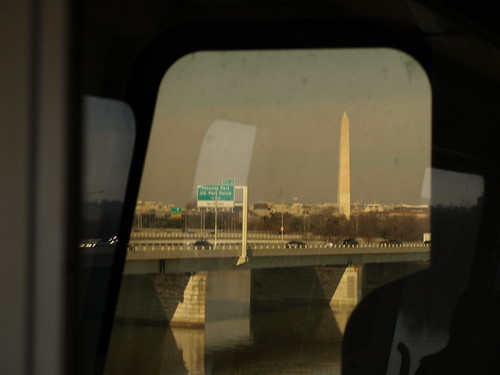
The yellow line bridge over the Potomac River

NoMa station with the view of the railyards and old Washington Colesium on one side, the Metropolitan Branch Trail on the other. Emerging from the tunnel out of Union Station into NoMa and the great view of the trains between buildings looking down 1st Street NE are also special.

First outbound approach into Tysons prior to the McLean station in 2014. That skyline looks different every time I ride out there.

Navy Yard station going to a Nats game from Stephen Strasburg’s debut; one of the highest ridership days ever.

Gallery Place/Chinatown, especially the fan, but also the entrance by the arch.

Fort Totten’s inside-outside design


Theme trains – cherry blossoms, holidays and more.
Some other things I like
- Traveling through closed Arlington Cemetery station at night when it’s closed
- Rosslyn station
- Silver Spring’s multi-modal overalp and penguins – I am eager to see it with the Purple Line (not Metro) finished
- the vaulted ceilings in Metro Center and L’enfant Plaza stations
- the sound of the Blue Line train passing over Holmes Run from my backyard
- Blowing past slow and stopped cars along the I-395 express lanes on my bus. Why doesn’t WMATA call these lines Bus Rapid Transit? It’s the best BRT we have in the region.
Personal stats
70
estimated stations entered/transferred/exited at in my lifetime
4
Lines “clinched”
I still need to get to Greenbelt and Largo
13
Age I started riding by myself
Annual Metro Tally Archive


Metro youtubers
There are a lot of foamers with youtube channels out there. Here are a couple of local ones that I enjoy watching.
Andy on Track
Great history of the system – each line is included in this playlist.
Trains are Awesome
Thom covers transit all over the world and lives in DC now.
Did you click? Now your algorithm just got sidetracked…
More coverage
Several media outlets in the region have covered the semicentennial of Metro rail service.
Washingtonian

“As our region’s iconic rail system turns 50, we ask the big questions—and some little ones, too.”
Greater Greater Washington
Why I’m celebrating 50 years of Metrorail magic
“When you think about it, subway travel is a magic trick. You go down one hole and, after some secretive manipulation, emerge from another, miles away. Every underground train arrival is a fresh dawn.”
There also metrobar’s UNOFFICIAL 50th Anniversary Party for the Metro! I may attend.

The 51st
As Metro turns 50, transit diehards are keepers of its history, quirks, and identity

That these collectors exist serves a bigger purpose, says Zachary Schrag, a George Mason University professor who literally wrote the book on Metro: “The Great Society Subway: A History of the Washington Metro.” Without them, he says, some of Metro’s history may well be lost altogether.
The Post
The very first ride. A surprise encounter. Memories of Metro’s 50 years.
I unsubscribed from the Post in 2024, so I haven’t actually seen this interactive. It may be worth going into one of the public library accounts I have to take a look.
It’s really terrible what became of that media property – I know people who worked and still work there. What one of the world’s richest men did to it is just a civic catastrophe.

Footnotes
- Dr. Schrag is the author of The Great Society Subway, published in 2006. I interviewed him that year. He is working on a new book Rail Against Sprawl: A History of the Dulles Corridor Metrorail Project. ↩︎
- I went on the New York Subway the previous year. I wouldn’t ride another subway system, PATH, until I was much older. Yes, I’m calling a subway, FRA. ↩︎
- If you had told me in college I’d be working in the same neighborhood as that awful Greyhound station, I would have thought my life took a very wrong turn… ↩︎
- The second phase to Ashburn via Dulles kind of felt that way too… ↩︎
- More than a decade of driving from inside the Beltway (I-395 corridor) to Tysons and back daily was more than enough. ↩︎